One of the more interesting recent developments in Chinese religious policy is an increasingly frequent official acknowledgment that religion has a role to play in the building of Hu Jintao’s “harmonious society.” Interesting because, for the first time since the 1940s, a Chinese government is acknowledging a positive role – albeit a limited one – for religion in Chinese society.
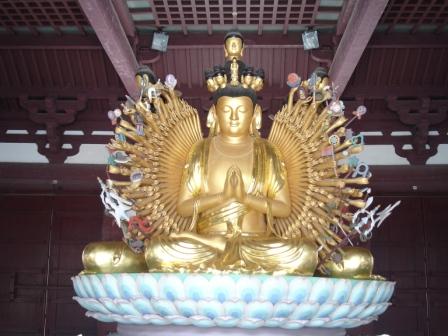
On Saturday, I visited the Yunxiang Temple in the town of Nanxiang, in Shanghai’s northwest Jiading District. It is a sprawling complex, and though there were a large number of tourists and/or faithful there, they seemed swallowed by the spaces until I reached the shrine at the furthest end. There I found crowds of mostly middle-aged women, many of whom were wearing this T-shirt:
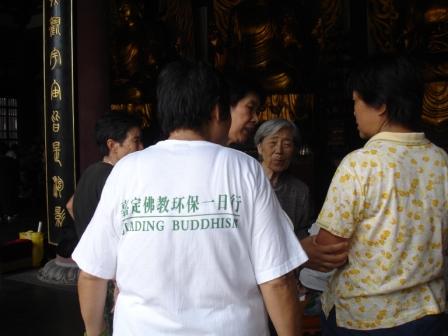
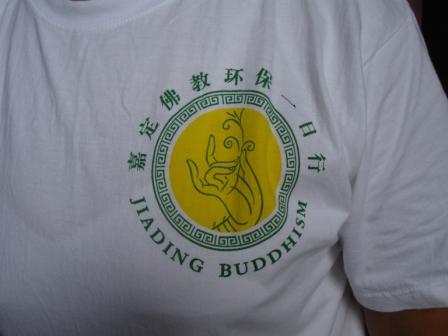
Roughly translated, the Chinese reads: “Jiading Buddhists’ Environmental Protection Tour Day.”
Now, this sort of thing might be commonplace in countries where Buddhists live and worship in less restrictive circumstances. But in China, where the government has – with purpose and determination – sought to drain even the slightest hint of politics from religious expression for more than half a century, it is stunning:
The Chinese friend who accompanied me to the temple is an avowed atheist raised in an era when politics and religion mixed only when the latter was used to criticize and control the other. Thus, he was just as surprised – in fact, more so – than me to see a group of women openly wearing T-shirts that implicitly suggest the need for a greater social focus on the environment — in a Buddhist Temple. After much discussion (and more than a few Nanxiang xiaolongbao [soup dumplings]), he conceded that this might, in fact, be a good thing. Below, a photo of the front of the shirt (the text reads the same as the back):
Neither the T-shirts nor my friend’s belated approval would have been possible if the highest levels of China’s religious authorities hadn’t made public comments in support of religion – and Buddhism, explicitly – as a source of environmental activism in the last year. Mopst notably last July, in his first cautious interview after a decade as director of China’s State Administration of Religious Affairs, Ye Xiaowen acknowledged that:
[T]here are a great deal of useful concepts, like peace, non-violence, harmony and balanced development, in Chinese religions, especially traditional ones, which can help advocate environmental protection and promote peace.
Some of this is obviously self-serving (what authoritarian government wouldn’t like to see its citizens adopt the “concept” of non-violence?), but some of it is more difficult to criticize. After all, developing a religiously motivated environmental consciousness among several hundred million Buddhists is not exactly in the best interest of [most of] China’s local government units.
I didn’t have the chance to speak at length to any of the Environmental Protection Tour participants (nor did I think it was appropriate for me – a reporter – to do so in a government-registered temple). But I did gather that the group hoped to do the tour again — but with more participants from within and without the Buddhist community. I have no idea how many people were involved in the Saturday tour – not all of them were wearing T-shirts. Whatever the numbers, below is a photo of the group and others setting into the temple for some readings.
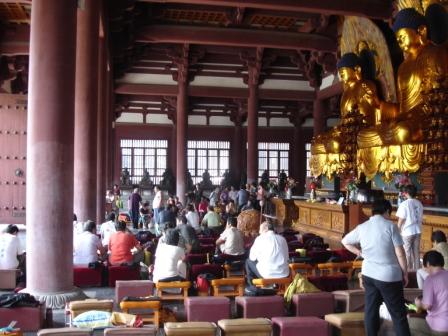
[I should note that, to my eyes, everyone seemed t0 be having a really good time together!]
Anyway, my speciality is Chinese Catholicism – not Buddhism – and so I’ll cut short this post by noting that Buddhists are not the only one of China’s five recognized religions adopting social concerns. Others, including Catholics, Protestant Christians and Muslims are taking on significant social service roles previously reserved for government agencies … a topic that I will be covering in other media very soon.