During the run-up to the November 12 release of my first book, Junkyard Planet: Travels in the Billion Dollar Trash Trade, every weekday I’m posting a new photo taken during my decade of reporting on the global waste, recycling, refurbishment, and repair trade. Today’s scene shows a worker taking apart and separating the various components that constitute a power strip. Click to enlarge.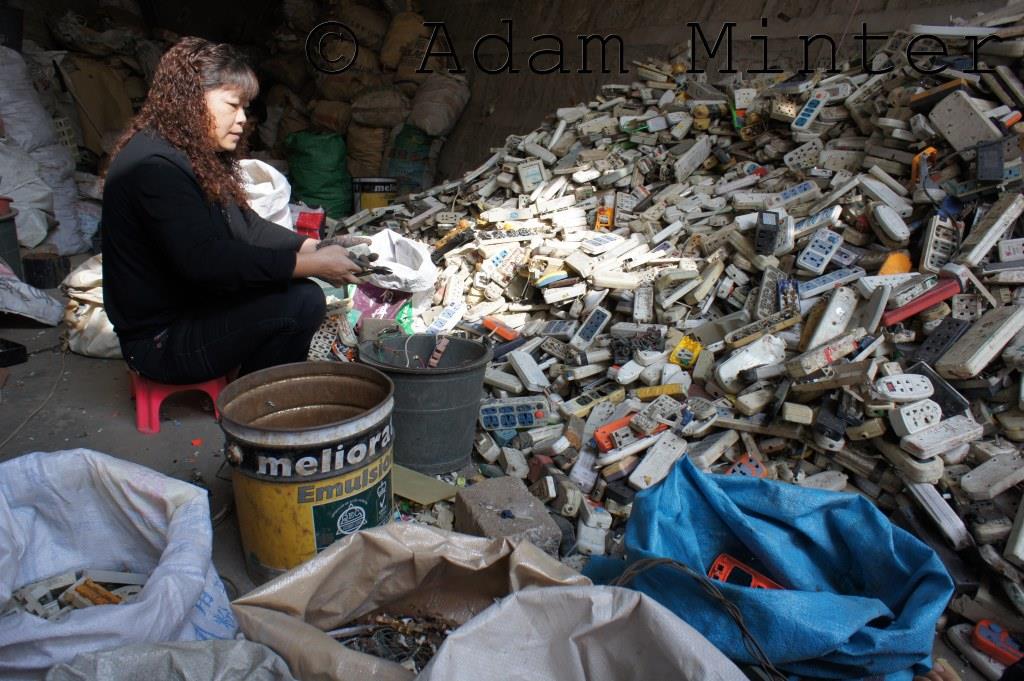
This 2011 image was taken in Guiyu, China, often referred to as the world’s most notorious dumping ground for electronic wastes. There’s some truth to that, but there’s also a great deal of complexity, too – starting with the simple fact that most of the so-called e-waste we find in Guiyu actually originates in China – not Europe, Japan, or the United States. Take, for example, the power strips in the above image. They’re all Chinese (easily verified by picking them up and examining labels). How many power strips are abandoned in China every year? There are no figures (and who would collect them, anyway?), but what we do know is that China is now the world’s largest market for PCs – a product class that often drives consumers to buy them. In this photo, the worker is breaking them apart by hand and segregating each of the respective materials – plastic cases, copper wires, circuit boards – into separate piles for recycling. In the US, EU and other developed world countries, these strips would be shredded into tiny pieces and separated by technologically sophisticated but inferior methods. Fact is, if you want to recycle something into its most basic states, hands are the greenest and most precise way to do it.
Previous ‘Scenes from a Junkyard Planet’ can be found here.