By design, private equity and the companies that manage it are among the business world’s most secretive instruments and organizations. Which is probably one reason why the Blackstone Group – one of the world’s largest private equity firms – appealed to China’s newly formed State Investment Corporation [apparently, the fund’s name has not been finalized], charged with obtaining higher returns from China’s US$1.2 trillion in foreign currency reserves.
In either case, in May the State Investment Corporation made its first major foreign investment by purchasing a US$3 billion piece of Blackstone’s US$7 billion IPO (roughly, 10% of the company’s equity). At the time, the Chinese didn’t have much to say about why they chose Blackstone, and Blackstone had only a little bit more to say about why they were willing to sell such a major stake to the Chinese. In a June 22 interview with CNBC, Blackstone CEO and co-founder Steven Schwarzman excused his company’s reticence by referring to the IPO:
You know, I am in the midst of working on an IPO and we have restrictions from our lawyers and the SEC in terms of what they call a “Quiet Period.” So I can’t talk about benefits to Blackstone, per se …
But Schwarzman is no stranger to Asia:
… what I’d say in a general sense is that having relationships in other parts of the world is always a good thing. And I think, given the way this particular country is organized, it certainly fits in that kind of rubric.
Fair enough, I suppose, but the question then becomes: Just what sort of relationship does Schwarzman get for accepting a US$3 billion investment in his company? With thanks to the webmaster at China’s State-Owned Assets Supervision and Administration Commission [SASAC], we now have an answer:
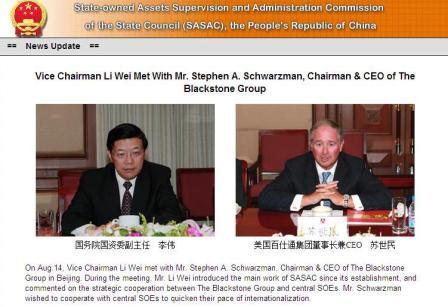
The print in the screen capture is small, so here it is, again, in bigger, clearer type:
During the meeting Mr. Li Wei introduced the main work of SASAC since its establishment and commented on the strategic cooperation between The Blackstone Group and central SOEs. Mr Schwarzman wished to cooperate with central SOEs to quicken their pace of internationalization.
[Despite having occurred three weeks ago, I have found no online references to this meeting, the Blackstone relationship to SASAC, or this odd little posting. If such a reference or report exists, I’ll link to it with a reference to the finder.]
Blackstone’s interest in Chinese SOE’s [state-owned enterprises] is not news. Earlier this year the company made a serious run at state-owned Guofeng Plastics. Indeed, foreign equity has been investing in Chinese state-owned firms for several years now. But what is interesting and unusual about the government-reported news from the SASAC meeting (aside from Blackstone almost certainly preferring that it not be posted) is its emphasis on cooperation, and the use of the plural in regard to SOEs. I wouldn’t want to read too much into this, but I think it’s fair to take away the impression that Blackstone’s involvement with China’s trillion-plus dollar state-owned industrial complex is much deeper than previous media reports – and the company – have suggested.
And this, too, is curious. After all, it seems unlikely that China’s State Investment Company will be pleased to learn that it invested US$3 billion into an asset manager now interested in purchasing notoriously inefficient and corrupt SOEs. So, perhaps, instead of outright acquiring SOEs, Blackstone really is “cooperating” – just as the SASAC suggests. And the most logical way for it to cooperate is to provide some sort of financing out of its $88 billion pool of managed assets.
Finally, there is the reference to helping “quicken their [the SOE’s] pace of internationalization.” In my experience, Chinese business executives recur to “international” as a euphemism for “modern.” In this context, I think the correct term probably is “modernization.” And there’s little question that China’s SOEs need modernizing at every level, from banking to labor practices. Blackstone wouldn’t be the first entity to attempt this thankless task; and, if it really gets involved, I imagine that it won’t be the last to learn that SOEs answer to the political, economic and military needs of China’s government before anything else – including profitability.