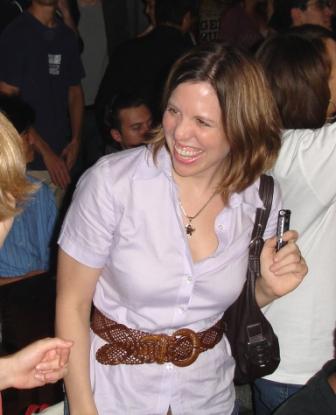
Cut to my friend Megan Shank, the Shanghai-based, soon-to-be former editor of Newsweek Select (the recently axed Chinese-language edition of Newsweek). Of all the journalists that I know, Megan’s job is/was the most challenging: namely, writing, editing, and translating Chinese and English language content for a major news weekly, while managing a staff. And somehow, through it all, she still managed to find time to do creative work.
So. On Friday night, East West Theater Group will premiere Impulse, a play that Megan co-wrote with Summer Block. Though “play” might be too restrictive a term. According to the official synposis, Impulse …
… considers the role of impulse in women’s lives. Through a series of monologues, silent sections and audience-driven improvisation, the East West Theater Group explores raw words and deeds that intermittently explode: Some tickle, some terrorize. Explore your subconscious – right after you stuff that cake in your mouth and call your ex.
Impulse premieres Friday night at Figaro Cafe, 168 Xingye Lu, at Xintiandi. Showtime is 19:00. Figaro will host additional performances on Saturday, also at 19:00, and on Sunday, at 15:00. RSVP tickets in advance (RMB 100, suggested donation, includes one glass of wine or coffee).
In advance of the premiere, and Megan’s April 2009 return to the US after five, Chinese-speaking years in China, I emailed a couple of – ahem – impulsive questions her way:
Scrap: So what’s a nice Newsweek editor like you doing, moonlighting as a Shanghai playwright?
Shank: I played with the idea of Impulse for a year and decided the theme was strong enough to pull something together. Because of my job, I functioned in this very Chinese-oriented, business-oriented sphere; writing the play was a joyful exercise to do something broader and more personally meaningful. The timing was great too. To use the language of this esteemed blog, Newsweek Select — ergo my job – is being scrapped, which has freed up more time to orchestrate production. And would you believe it? Community theater pays nearly as handsomely as journalism, and actors’ neurosis are much more charming than writers’. It’s gotta be the moxie.
Scrap: Do you find your creative work is enhanced and/or informed by your work in the world of journalism?
Shank: As journalists we’re fortunate because we’re tasked with listening for a living. When we’re still, present observers who set aside our judgments, we witness so much subtle seduction and quiet annihilation; we witness people struggle to quietude. I’ve written fiction for years, though I mostly keep it for myself (here’s a piece I can share), and it’s generally inspired by something I’ve seen on the street or heard in a conversation. My imagination creates the climax and delivers the denouement. As journalists we stick to the facts; as creative writers, we manipulate the truth to make it more true. For this play, I will request the audience members share their impulses not only for a short improvised skit in the middle of the performance, but also for the development of the entire piece. I intend to follow up with journalistic interviews and add new monologues after each round of performances so that, for example, a performance in Iowa City, Iowa, six months from now will have organically evolved from the creation witnessed in Shanghai. I think in journalism and creative writing, it’s essential to remain relevant and surprising.
Scrap: The play explores “the role of impulse in women’s lives.” Would the answer to that particular question – if there is an answer – be any different if you hadn’t spent half-a-decade in China?
Shank: I’m not sure if I would still have this constant impulse to kick cars.