From the moment that Expo 2010 (World’s Fair) was awarded in December 2002, the preemptive critics were ready to accuse the host country of presenting a watered-down, white-washed version of Shanghai, and China, for domestic and international consumption. And, to an extent, they were onto something: the China pavilion, and the Chinese provincial pavilions do, in fact, present a sanitized picture of contemporary and historical China. That is to say, if you go to the Expo looking for stories of migrant workers, of China’s factory culture, of its ongoing identity crisis that pits traditional culture against the chaos of market-oriented modern China, well, you won’t find it. But, then again, neither will you find stories about America’s homeless at the USA pavilion; understandably, nobody wants to air their dirty laundry at a World’s Fair. Instead, Expo 2010 exhibitors are all about progress, the ongoing march from history into the glorious present.
At least, that’s what I thought before I walked into the Shenzhen Case Pavilion and found myself standing in a shipping container hung with fake Van Goghs illuminated by a photograph of (some of) the young, shirtless artists responsible for painting the canvases. Shenzhen, for those unfamiliar with it, became China’s first Special Economic Zone in 1980, and has since been both a laboratory for free market reform, and a politically volatile symbol of China’s successes and failures as a market economy.

In any case, most of the trickle of tourists rushing through the tight pavilion space didn’t recognize – or seem to care about the paintings and artists – but I sure did. They are both from Dafen Art Village (located in Shenzhen’s sprawling outskirts), the semi-famous, oft-written-about (most recently in the July 20 edition of the Vancouver Sun) village where 60% of the world’s “original” copied oil paintings are produced mostly for export (to Wal-Mart and other mass market retailers in developed countries) by 8000 former art students and anyone else with the talent to duplicate an Old Master (or Warhol, or Chen Danqing, or whoever).
What’s unusual about this exhibit, particularly at Expo 2010, is that it highlights an unglamorous, low-tech, labor intensive Chinese industry (with zero benefit to the environment), and it does so in a way that emphasizes the hard work, low pay, and tough lifestyle of its laborers. What’s interesting about the exhibit is that Shenzhen actually happens to be home to much of the world’s high-tech manufacturing (for more on this, see James Fallows’s seminal 2007 piece on the city’s manufacturing economy at the Atlantic; and Fallows on Dafen, here). Put differently, at an event where other countries and Chinese provinces often exaggerate their high-tech manufacturing capacities and scrub-wearing labor forces, Shenzhen – which has both in abundance – chooses to highlight its 8000 low-paid Old Master copyists – and to do so with pride. Just get a look at these faces …

For whatever reason (inexcusable disinterest?) the foreign and Chinese media seem to have missed and/or ignored what Shenzhen’s pavilion is doing. And that’s a pity, because not only is it interesting, it’s also borderline subversive. For example, take a look at this carefully phrased explanation of the pavilion posted to the website of Urbanus, the pavilion’s Shenzhen-based designers:
[The Shenzhen pavilion] tries to avoid epic-like presentations and empty talks. Instead, it proceeds from a specific case: the development and regeneration of Dafen village, and tells a story about how people as the ultimate driver of all the miracles created over the past thirty years, have shaped the drastic changes of this young city. It is a story about people, their dreams and creativity, as well as the culture, spirit and vision of this city.
Now, if Dafen were the extent of the Shenzhen pavilion, that would be enough to qualify it as one of the most interesting at an Expo that – admittedly – doesn’t have many interesting pavilions. But in fact, Dafen is mere prelude to what comes next: a remarkable 15-minute video that – in ways subtle and not – offers a blunt critique of the widening gap between rich and poor in Shenzhen, and the policymakers who set off the market forces which created that gap (ie, Deng Xiaoping).
So. The film, “Shenzhen Faces” is projected (poorly) on a wall outside of the Dafen portion of the pavilion. It’s roughly 15 minutes long, and it memorializes a day in the life of Shenzhen. It begins in the early morning hours, in an operating room at a gynecological clinic. Like the rest of the film, there’s no dialogue – just a dramatic soundtrack of Wagner and other romantic composers. In any case, at the moment that I first happened upon the film, a caesarean was in progress – much to the horror of several female visitors, who screeched.
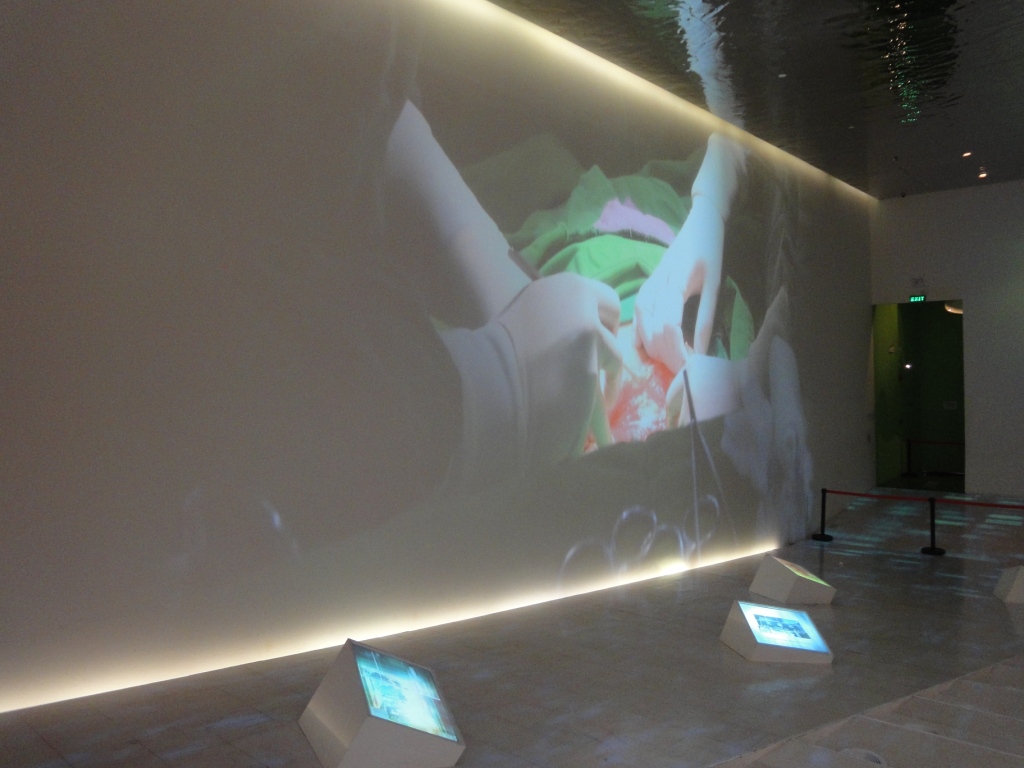
One might wonder: of all the things that you could open a ‘day in the life of Shenzhen’ with, why choose a caesarean? No idea. Perhaps the filmmakers are taking a not-so-subtle shot at the 50% and growing caesarean rate at Chinese hospitals? Or perhaps, by placing the procedure at the beginning of the film, they hoped to distract the Expo censors (are there any? I don’t know) from what comes later in the film. That’s my theory.
But first: it wasn’t easy to photograph the faintly projected film and, unfortunately, most of my photos of it aren’t worth posting. So you’ll have to bear with my descriptions.
From the hospital, the film shifts to all-night seafood and produce markets. The footage isn’t anything unusual if you’ve ever walked around a Chinese city at dawn: weary-looking farmers and fishermen set out their goods for sale as trucks rumble down narrow alleys. But I can’t think of another Chinese Expo 2010 pavilion that highlights this sweaty facet of contemporary Chinese life.
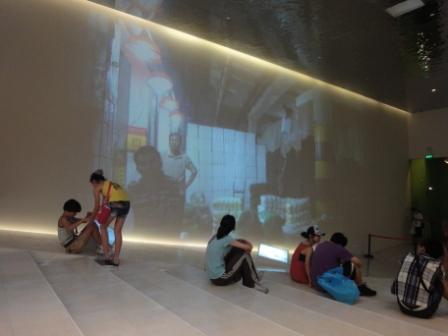
When daylight arrives the film shifts to a carwash, where scrawny workers are shown scowling as they wipe down expensive sports cars (lots of black government Audis). The filmmakers go out of the way to linger on the unhappy faces of the workers, and then cut to the shiny trim of the cars that they wash by hand.

From there, the film moves to the OCT LOFT market where young designers exhibit their works for sale, and then – in a subversive shift – lingers on the famous downtown billboard image of Shenzhen’s free market architect, Deng Xiaoping. From Deng, the film cuts to a yacht club, where several affluent-looking men are getting ready to launch their Hong Kong-flagged sail boat. Then the film cuts back to Deng. Then the film cuts back to the sailboat full of wealthy men. Then back to Deng. Then the sailboat of affluent men en route to Hong Kong. No text or words are spoken, but the effect of the back-and-forth is powerful: Deng, to a yacht, Deng, to a yacht, Deng, to a yacht. This isn’t subtle stuff (a photo of the billboard that I took a few years ago).

To my mind, though, the most powerful section of the film takes place toward the end, in the kitchen of the Shenzhen Ritz-Carlton. It’s late at night, but the large staff is hard at work, preparing complicated dishes. Repeatedly, the camera bounces between hands hard at work, and then up to the unhappy, often pained faces of the chefs.
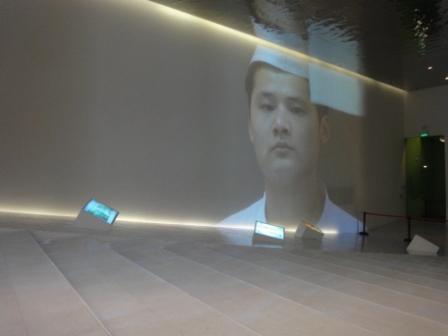
The sequence is long, perhaps three or four minutes, and it includes well over a dozen faces – not one of which smiles. Rather, the accumulated frowns leave the viewer with the overriding impression that working in the Ritz-Carlton kitchen is nothing but misery.

Finally, after several minutes of these unhappy images, two chefs pick up two plates of (what appears to be) foie gras, walk out of the kitchen and into a posh corridor. Then, just as they’re about to enter a private dining room, the screen fades to black.
It’s an incredibly powerful, not terribly subtle, moment of social criticism of the kind that I haven’t seen anywhere else at the Expo. I have no idea how or why this was allowed to be made, much less be shown, but I’d suspect that the remote location of the Shenzhen pavilion, in the boring-as-it-sounds Urban Best Practices Area, had something to do with it. But perhaps the best explanation comes from a May 2010 ArchDaily piece (which is, in part, lifted from the Urbanus website).
[O]ne thing is for sure, Shenzhen is much more than just a materialized city to the Chinese people. It is also a hometown of the Chinese spirit, a frontier for their dreams. It is a dream, first and foremost, of the whole nation, and Shenzhen’s struggle to shake off her shackles also represents the struggle of the entire nation. It is a self-made, unconventional and unorthodox region in a centralized state, moreover, its remoteness to the center of power and its relatively marginal status also provides a good opportunity for it to be more open, inclusive and bold. On the other hand, its connection with the outside world helps build a window through which the city exchanges and interacts with the outside world and with its double identity it is an ever-open gate.
[Addendum: It’s a real pain in the neck to get over to the Shenzhen pavilion, but if you have the time and inclination, it’s worth it. To do so, take one of regular shuttles from the center of the Puxi side of the Expo, to the Urban Best Practices Area. The signage is decent, and you’ll have no problem finding it.]
Looks like the SZ pavilion will make me homesick 🙂
Who produced the video–was it credited?
Jen – The entire pavilion – film and all – was done by Urbanus.
Pretty amazing that nobody noticed this until Expo was already more than half over.
I had a search on the urbanus website, and youku, for the video, but sadly to no avail. It would be great if it could be tracked down online.
This is really excellent, heart-breaking stuff, well done Adam! And well done Shenzhen for being this forthright and willing to examine itself so honestly and poetically. Beautiful.
I’ve been taking friends and relatives to Dafen for years and I’m delighted to see that it’s featured at Expo.
Interesting! Off the top of your head can you think of any other pavilions that are political like this one?
I saw the German importer of these paintings on German news. He’s making a fortune selling these paintings to Germans who consider these masterpieces to represent Eurocentric talent.
Asked around with your Chinese friends yet? I just keep on remembering the passage in The Chrysanthemum and the Sword where Ruth Benedict describes Japanese pro-war propaganda movies that to the Western eye look remarkably like anti-war movies, with senseless drudgery and finales in some nameless dirt-poor Chinese hamlet. This is supposed to be stirring, as it represents the selfless performance of duty with no promise of glory.
Inst – A good point, but I think it misses. The Shenzhen film is pretty clearly a questioning – if not criticism – of the growing income gap in the Pearl River Delta. The back and forth between the yacht, and the Deng billboard is only the most unsubtle clue. There are others In any case, my Chinese friends with whom I’ve discussed it feel similarly.
I’m working on getting a link to a download of the film. If I do, I’ll post it for viewing and discussion.
The film you describe was gone by the time I attended Expo in September. It was replaced by a film on the history of Dafen, of which I took many still photographs if anyone’s interested. Yes please let us know if you can link the original film – clearly it was replaced by something less critical. Another film query – can anyone provide info on/access to the 8-minute harmony video, “The Journey” by Lu Chuan that was shown in the China Pavilion? Many thanks, Carolyn
I’m researching about Dafen for my master thesis, I’m interested in how different discourses (both in Western countries and China) are being built about this oil painting village, because I think that analyzing these discourses underlines the different views one can have about China and Art in general. I found your article very interesting. But, like Inst, I wonder if the Shenzhen Pavillion was really as subversive as you said… Don’t you think the Shenzhen government could also be proud just of the fact that people can get a job easily there ? Even if these jobs seem quite terrible to us, maybe the aim of the pavillion is just to show that Shenzhen is a city which has a culture, an identity (despite what people often think…), and which is able to provide a job to its people…..