During the run-up to the November 12 release of my first book, Junkyard Planet: Travels in the Billion Dollar Trash Trade, every weekday I’m posting a new photo taken during my decade of reporting on the global waste, recycling, refurbishment, and repair trade. Today’s image shows a group of wire strippers in Sylvassa, India. This is the same factory where yesterday’s scene was shot. Click for an enlargement:
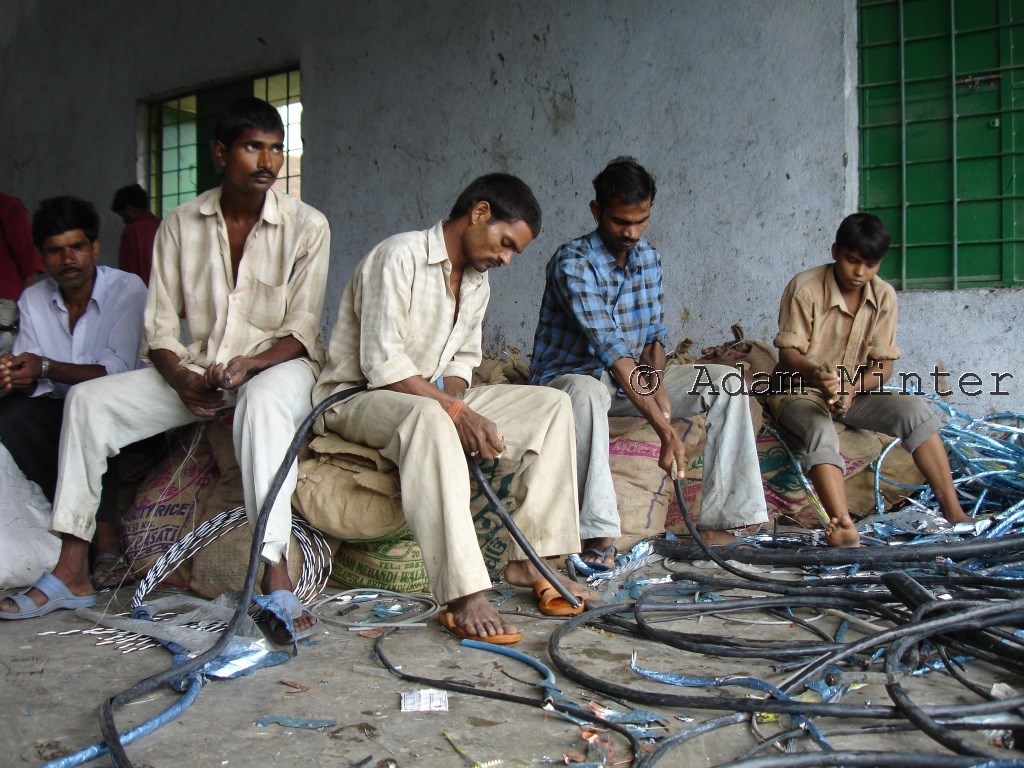
This 2006 image shows an activity familiar to scrap workers in developing countries around the world, and through history: stripping insulation from wire. As I’ll show later in the week, there are easier ways to do this. But in India, where the cost of labor remains vanishingly small, few recycling businesses feel there’s much cost or efficiency advantage in purchasing machines to speed this work. Stripping wire produces two commodities of significant value: copper, and plastic insulation. Were the plastic not valuable – and, before developing Asia emerged as a competitor for oil, it wasn’t – the cable would most likely be burnt, thus saving time and energy (neglecting, for now, laws and regulations that prohibit the practice). It’s worth noting that this activity, though very much centered in developing Asia and (to a lesser extent) Africa, was once widely done by Europeans and Americans, often in their homes, right up to the 1960s. My grandmother, in fact, recalled doing the work for her father. What changed was rising demand for copper in the developing world, the rising cost of labor in the developed world, and savvy entrepreneurs who saw opportunities in shipping recyclables from rich countries, to countries eager to become rich.
Previous ‘Scenes from a Junkyard Planet’ can be found here.